Send Us a Message
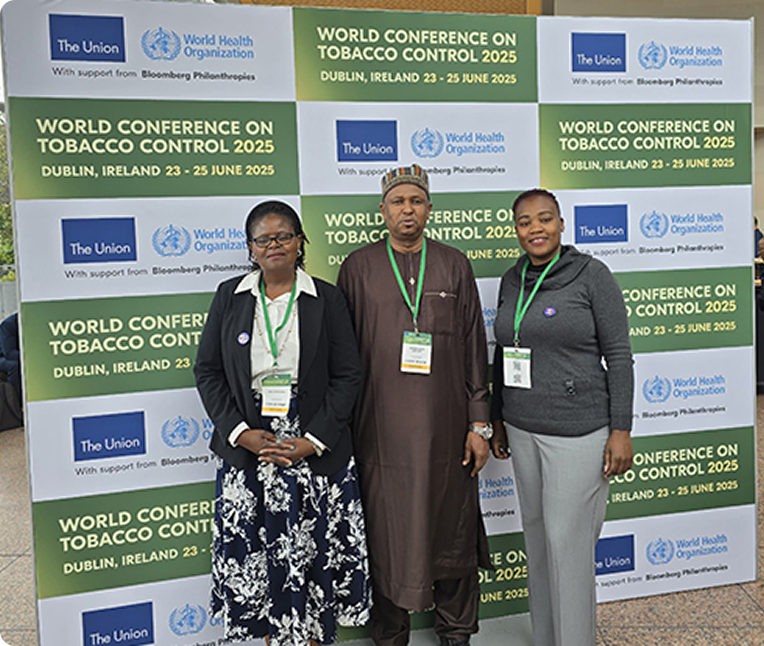
At the 2025 World Conference on Tobacco Control in Dublin, Ireland, global health leaders issued a renewed call to action through the Dublin Declaration. With its five clear priorities—raising tobacco taxes, countering industry interference, banning advertising and sponsorship, addressing environmental harms, and strengthening cross-sectoral collaboration. The declaration reflects a shared urgency to end the global tobacco epidemic. The continent’s critical gap isn’t ambition—it’s institutional capacity.
For Africa, however, realizing this vision demands more than bold commitments. It requires building strong, coordinated, and sustainable institutions capable of designing, implementing, monitoring, and enforcing tobacco control policies.
Bridging the Implementation Gap in Africa
Despite growing momentum across the continent, a significant implementation gap persists. While 44 African countries have ratified the WHO Framework Convention on Tobacco Control (FCTC), only a few—such as Ethiopia, Mauritius, and Ghana—have made strong progress in rolling out the MPOWER measures.
Many countries still face:
- Weak inter-ministerial coordination on FCTC implementation.
- Insufficient technical expertise and tools to monitor taxation, counter illicit trade, or enforce bans.
- Underfunded national tobacco control programs, often reliant on short-term external funding.
- Limited integration of tobacco control into national development plans, health systems, and education strategies.
Without targeted investments in institutional capacity, the aspirations of the Dublin Declaration will remain out of reach.
ACBF’s Role: Investing in Institutional Resilience
The African Capacity Building Foundation (ACBF)—the AU’s specialized agency for capacity development—has been advancing tobacco control efforts in Africa since 2014. Now in its third program phase (2023–2027), ACBF continues to support governments, civil society, and research institutions to implement WHO-FCTC provisions effectively.
Key Achievements:
- Supported the adoption of tobacco legislation in The Gambia, Gabon, Ethiopia, and Mauritania.
- Strengthened the operational capacity of at least 13 civil society organizations (CSOs) to monitor, advocate, and respond to industry tactics.
- Equipped CSO organizations and University Departments with governance systems, leadership training, and tailored resource mobilization strategies.
- Helped establish national tobacco control committees in countries such as Zambia, Niger, and Benin.
Unlike short-term project models, ACBF’s approach focuses on long-term institutional sustainability, embedding tobacco control within national systems and capacities that can endure beyond donor cycles.
Aligning with the Dublin Declaration: Strategic Priorities
To translate the Dublin Declaration into concrete action in Africa, ACBF- together with other regional partners in tobacco control will continue scaling support in five key areas:
1. Sustainable Financing Through Tobacco Taxes
- Build technical skills in Ministries of Finance for tax modeling and simulation.
- Support the creation and management of national tobacco control funds.
- Empower CSOs to monitor implementation and advocate for sustainable funding.
2. Countering Industry Interference
- Promote adoption of the Illicit Trade Protocol.
- Develop conflict-of-interest policies aligned with FCTC Article 5.3.
- Strengthen watchdog institutions and trace-and-track mechanisms.
3. Enforcing Bans on Promotion and Advertising
- Support content regulation in entertainment industries like Nollywood.
- Equip media authorities with tools to monitor digital platforms.
4. Addressing Environmental Impacts
- Engage Ministries of Environment and Agriculture on crop diversification and pollution reduction.
- Support environmental impact assessments and data tracking.
5. Promoting Multi-Sectoral Collaboration
- Facilitate coordination among national agencies, the AU, Africa CDC, and RECs.
- Build research institutions’ ability to generate local evidence for policy influence.
- Expand learning platforms through initiatives like the Ubora Academy and regional training centers.
From Promise to Progress
The Dublin Declaration represents a vital global recommitment to end the tobacco epidemic. But in Africa, where policy ambition often outpaces institutional readiness, building resilient institutions must be the priority.
ACBF remains committed to this agenda. Through targeted investments and strategic partnerships, we will continue to strengthen the tobacco control community by empowering governments, CSOs, and research bodies to lead Africa’s response with independence, credibility, and sustainability.
Ending tobacco use in Africa is possible—but only if we build the institutions capable of delivering lasting change.


For more information, contact:
Fatou Diouf, Head of Communications and Influencing
comms@theacbf.org
Follow us on:
www.linkedin.com/company/africa-capacity-building-foundation
www.twitter.com/ACBF_Official
www.intstagram.com/theacbf
www.facebook.com/TheACBF