

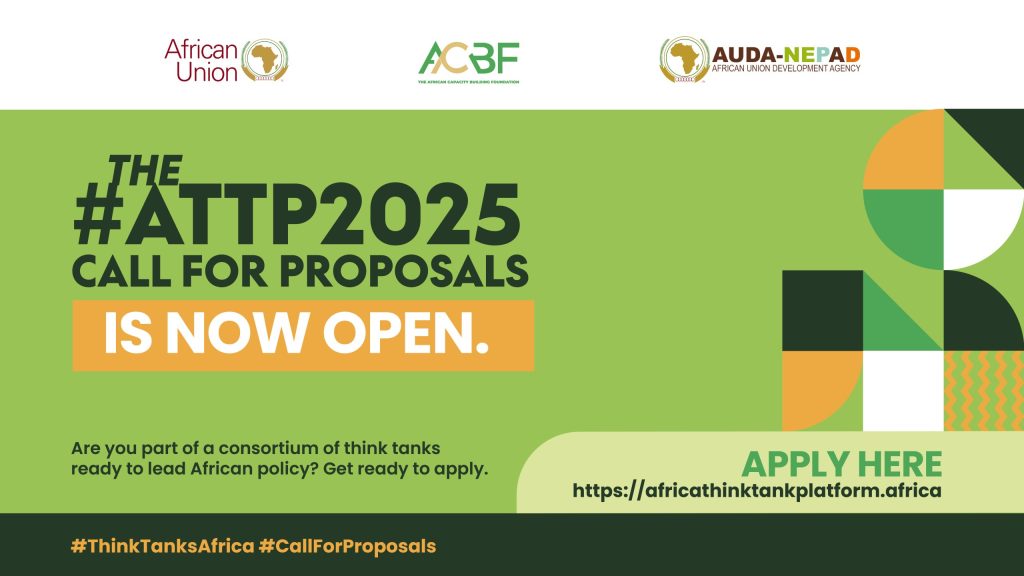
African Union, ACBF, and AUDA-NEPAD Launch Call for Proposals to Strengthen Africa’s Policy Research Capacity
Addis Ababa, Ethiopia | 24 July 2025
The African Union Commission (AUC), in collaboration with the African Capacity Building Foundation (ACBF) and AUDA-NEPAD, has launched a competitive Call for Proposals under the Africa Think Tank Platform (ATTP). This transformative initiative elevates African think tanks as architects of cross-border development policy. The World Bank provides strategic funding support for this ground-breaking program.
The Call for Proposals invites consortia of 3 to 5 African think tanks to pursue multi-year funding for collaborative, policy-relevant research across six thematic areas, including economic transformation and governance, climate change, regional trade, food security, human capital development, and digitalization. Between three and five consortia will be selected and receive grants of approximately US$10 million for up to two and a half (2.5) years to support programs aligned with the aspirations of Agenda 2063 and regional integration priorities.
Speaking at the hybrid launch event at African Union Headquarters in Addis Ababa, Her Excellency Selma Malika Haddadi, the Deputy Chairperson of the African Union Commission, highlighted the initiative’s broader vision by stating, “This represents a strategic investment in Africa’s ability to lead its own policy conversations with rigor, data, and indigenous expertise.”
The Call marks the first operational phase of the ATTP, aiming to establish a continent-wide network of authoritative institutions that produce evidence-based knowledge, engage decision-makers, and contribute to unified policy frameworks.
Application Timeline
- Proposal Deadline: 24 September 2025
- Evaluation and Selection: 17 October 2025
- Expected Award Notification: 14 November 2025
- Expected Grant Disbursement: 19 December 2025
Regular webinars and a help desk will support applicants throughout the process. Think tanks interested in applying are encouraged to review the full application package and submission guidelines at https://africathinktankplatform.africa/callforproposal.
———————————————–END——————————————
About the Africa Think Tank Platform
The Africa Think Tank Platform (ATTP) is a five-year, US$50 million initiative implemented by the African Union Commission (AUC) and supported by the African Capacity Building Foundation (ACBF) and AUDA NEPAD, with funding from the World Bank. The ATTP aims to strengthen Africa’s policy research ecosystem and advance evidence-based policymaking on cross-border development priorities.
The ATTP responds to the need for strong, well-resourced African think tanks that can generate and apply context-specific knowledge to shape regional and continental agendas. As emphasized in the Africa Capacity Report 2017, creating enabling environments for local research institutions is essential to achieving sustainable development across the continent.
For interviews or media inquiries, please contact:
Fatou Diouf
Head of Communications & Influencing
The African Capacity Building Foundation
2 Fairbairn Drive, Mount Pleasant, Harare, Zimbabwe
Email: Comms@acbf-pact.org
At the 2025 World Conference on Tobacco Control in Dublin, Ireland, global health leaders issued a renewed call to action through the Dublin Declaration. With its five clear priorities—raising tobacco taxes, countering industry interference, banning advertising and sponsorship, addressing environmental harms, and strengthening cross-sectoral collaboration. The declaration reflects a shared urgency to end the global tobacco epidemic. The continent’s critical gap isn’t ambition—it’s institutional capacity.
For Africa, however, realizing this vision demands more than bold commitments. It requires building strong, coordinated, and sustainable institutions capable of designing, implementing, monitoring, and enforcing tobacco control policies.
Bridging the Implementation Gap in Africa
Despite growing momentum across the continent, a significant implementation gap persists. While 44 African countries have ratified the WHO Framework Convention on Tobacco Control (FCTC), only a few—such as Ethiopia, Mauritius, and Ghana—have made strong progress in rolling out the MPOWER measures.
Many countries still face:
- Weak inter-ministerial coordination on FCTC implementation.
- Insufficient technical expertise and tools to monitor taxation, counter illicit trade, or enforce bans.
- Underfunded national tobacco control programs, often reliant on short-term external funding.
- Limited integration of tobacco control into national development plans, health systems, and education strategies.
Without targeted investments in institutional capacity, the aspirations of the Dublin Declaration will remain out of reach.
ACBF’s Role: Investing in Institutional Resilience
The African Capacity Building Foundation (ACBF)—the AU’s specialized agency for capacity development—has been advancing tobacco control efforts in Africa since 2014. Now in its third program phase (2023–2027), ACBF continues to support governments, civil society, and research institutions to implement WHO-FCTC provisions effectively.
Key Achievements:
- Supported the adoption of tobacco legislation in The Gambia, Gabon, Ethiopia, and Mauritania.
- Strengthened the operational capacity of at least 13 civil society organizations (CSOs) to monitor, advocate, and respond to industry tactics.
- Equipped CSO organizations and University Departments with governance systems, leadership training, and tailored resource mobilization strategies.
- Helped establish national tobacco control committees in countries such as Zambia, Niger, and Benin.
Unlike short-term project models, ACBF’s approach focuses on long-term institutional sustainability, embedding tobacco control within national systems and capacities that can endure beyond donor cycles.
Aligning with the Dublin Declaration: Strategic Priorities
To translate the Dublin Declaration into concrete action in Africa, ACBF- together with other regional partners in tobacco control will continue scaling support in five key areas:
1. Sustainable Financing Through Tobacco Taxes
- Build technical skills in Ministries of Finance for tax modeling and simulation.
- Support the creation and management of national tobacco control funds.
- Empower CSOs to monitor implementation and advocate for sustainable funding.
2. Countering Industry Interference
- Promote adoption of the Illicit Trade Protocol.
- Develop conflict-of-interest policies aligned with FCTC Article 5.3.
- Strengthen watchdog institutions and trace-and-track mechanisms.
3. Enforcing Bans on Promotion and Advertising
- Support content regulation in entertainment industries like Nollywood.
- Equip media authorities with tools to monitor digital platforms.
4. Addressing Environmental Impacts
- Engage Ministries of Environment and Agriculture on crop diversification and pollution reduction.
- Support environmental impact assessments and data tracking.
5. Promoting Multi-Sectoral Collaboration
- Facilitate coordination among national agencies, the AU, Africa CDC, and RECs.
- Build research institutions’ ability to generate local evidence for policy influence.
- Expand learning platforms through initiatives like the Ubora Academy and regional training centers.
From Promise to Progress
The Dublin Declaration represents a vital global recommitment to end the tobacco epidemic. But in Africa, where policy ambition often outpaces institutional readiness, building resilient institutions must be the priority.
ACBF remains committed to this agenda. Through targeted investments and strategic partnerships, we will continue to strengthen the tobacco control community by empowering governments, CSOs, and research bodies to lead Africa’s response with independence, credibility, and sustainability.
Ending tobacco use in Africa is possible—but only if we build the institutions capable of delivering lasting change.


For more information, contact:
Fatou Diouf, Head of Communications and Influencing
comms@theacbf.org
Follow us on:
www.linkedin.com/company/africa-capacity-building-foundation
www.twitter.com/ACBF_Official
www.intstagram.com/theacbf
www.facebook.com/TheACBF
Geneva, Switzerland, 13–15 May 2025
The African Capacity Building Foundation (ACBF) participated in the Global Conference on Cyber Capacity Building (GC3B) in Geneva, Switzerland, joining African and international leaders, policymakers, and experts to advance the continent’s digital transformation and address the critical need for cyber resilience.
At this global forum, ACBF strongly urged African countries and partners to adopt a united, homegrown approach to building the continent’s cyber capacity—emphasizing African ownership, collaboration, and practical investment in skills and systems.
The conference provided a vital platform for dialogue and partnership, with a strong focus on Africa’s unique challenges and opportunities in cybersecurity capacity building. The key highlights of the conference were:
Africa Declaration on Cybersecurity Capacity Building:
A central outcome of the conference was the presentation and firm endorsement of the Africa Declaration on Cybersecurity Capacity Building by the participants. This declaration reflects a united commitment by African stakeholders and partners to prioritize and coordinate efforts in building cybersecurity capacity across the continent. It outlines shared principles and concrete actions to foster cooperation, resource mobilization, innovation, and the development of a skilled cyber workforce.
Focus on Collaboration and Sustainable Investment:
Discussions highlighted the importance of working together across sectors and borders to address Africa’s cybersecurity challenges. Participants emphasized that building cyber capacity is not a luxury, but an essential part of Africa’s development. There was a strong call for innovative approaches to funding, knowledge exchange, and the strengthening of regional and continental partnerships.
Advancing Practical Capacity Building:
The conference showcased a range of practical models and experiences in cybersecurity training, technical assistance, and knowledge sharing. Emphasis was placed on hands-on education, the development of technical expertise, and the need to empower Africa’s growing digital workforce to meet evolving security threats.
Commitment to Inclusive and Sustainable Digital Growth:
Participants reaffirmed the need for inclusive strategies that ensure all segments of society benefit from digital transformation, while remaining protected against cyber risks. The importance of digital literacy, public awareness, and ongoing investment in people and systems was underscored throughout the discussions.
ACBF’s Commitment
As Africa’s leading institution for capacity development, ACBF remains dedicated to supporting member states and regional organizations in building robust cyber capacity. The Foundation will continue to foster partnerships, promote best practices, and facilitate access to training and resources, ensuring that Africa’s digital transformation is secure, inclusive, and sustainable. ACBF will continue to advocate for a unified, coordinated, and homegrown approach—where member states, institutions, and partners work hand in hand to secure the continent’s digital future.
Looking Ahead
The GC3B conference and the Africa Declaration on Cybersecurity Capacity Building reaffirm the importance of collective action and knowledge sharing. ACBF looks forward to leveraging the insights and partnerships gained in Geneva to further advance Africa’s cyber resilience and digital growth.


For more information, contact:
Fatou Diouf, Head of Communications and Influencing
comms@theacbf.org
Follow us on:
www.linkedin.com/company/africa-capacity-building-foundation
www.twitter.com/ACBF_Official
www.intstagram.com/theacbf
www.facebook.com/TheACBF
https://theacbf.org