
ACBF, ABF, GIZ, and IAPA transform 58 field-tested innovations into transferable knowledge to scale climate-resilient investments and business models across Africa.
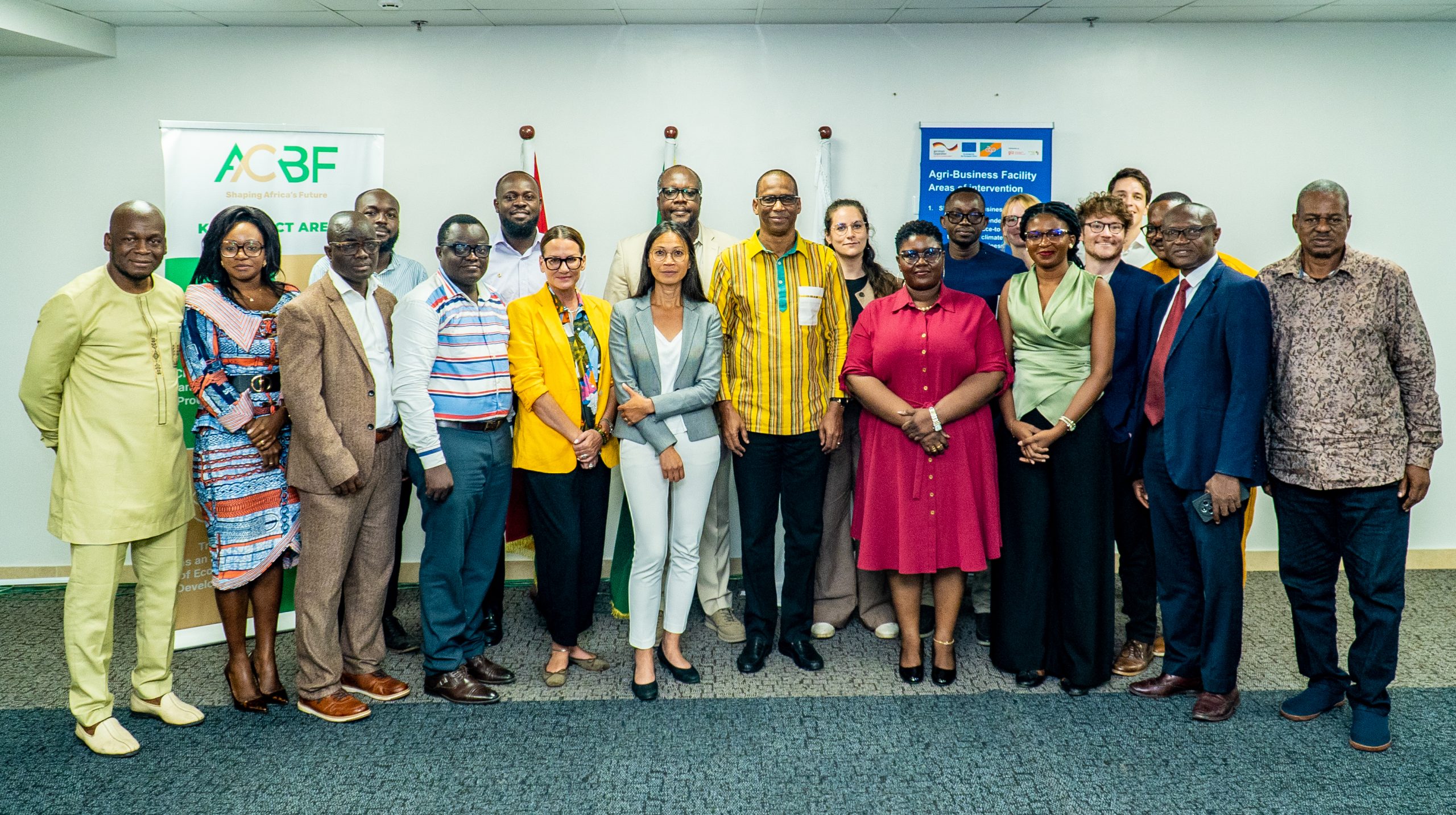
The African Capacity Building Foundation (ACBF), in collaboration with the Agribusiness Facility for Africa (ABF), the German Agency for International Cooperation (GIZ), and the International Agribusiness Practitioners Association (IAPA), convened technical experts, private sector actors, academics, and development institutions in Accra, Ghana on May 7–8, 2026, to assess innovations emerging from climate-resilient cocoa, livestock, and maize value chains.
The Best Practices Selection Workshop formed part of a knowledge capitalization process designed to convert field-tested experience into evidence-based resources for policymakers, investors, and development practitioners.
Participants assessed 58 good practices drawn from more than 65 projects supported by the ABF Matching Grant Fund across Africa, the Caribbean, and the Pacific.
African agriculture accounts for 46% of total employment on the continent, the highest regional share globally, and contributes roughly a third of GDP across most member states, according to the Food and Agriculture Organization and the African Development Bank.
Proven innovations rarely travel beyond the contexts in which they were developed, and the demand for climate-resilient approaches is growing as producers and agribusiness enterprises face intensifying environmental pressures and shifting market conditions. Addressing this gap sits at the heart of Agenda 2063’s vision for knowledge-driven agricultural transformation across the continent.

The workshop constitutes a key milestone in our knowledge capitalization agenda,” said Barassou Diawara, Senior Knowledge Management Expert at ACBF. “At ACBF, we are increasingly focused on identifying what works across Africa and ensuring those lessons are captured, validated, and shared.
Barassou Diawara
Senior Knowledge Management Expert at ACBF
Peer Learning and Scalable Innovation

ABF transforms locally developed innovations into transferable knowledge and investment-ready approaches.The process is designed to support the scaling of proven agribusiness approaches across different markets and contexts.
Simon Striegel
Head of Component at ABF/GIZ
Participants assessed 58 Good Practices implemented across cocoa, livestock, and maize value chains. The review focused on innovations that demonstrated measurable impact, viable business models, operational feasibility, and the capacity to adapt across different agricultural and market environments.
The portfolio spanned 14 countries, from digital traceability systems for cocoa in Uganda and the Democratic Republic of Congo to hermetic storage and aggregation models for maize in Malawi and Tanzania, and circular crop-livestock integration approaches in Ghana and Burkina Faso.
The process positioned partner-developed solutions at the center of the learning agenda. ABF facilitated the identification and dissemination of approaches that have already been tested and implemented by private-sector actors working across African agricultural systems.
The workshop highlighted the growing demand for climate-resilient investments across African value chains as producers and agribusiness enterprises respond to environmental pressures, market shifts, and evolving food security priorities. Participants examined innovations that improve productivity, strengthen resilience, support market access, and expand opportunities for value addition.
Several practices demonstrated strong potential for broader adaptation because they combined practical implementation pathways with realistic investment requirements and clear economic returns for value chain actors. Participants also emphasized the importance of fostering partnerships to achieve successful implementation outcomes.
One of the key lessons from the workshop was the importance of partnerships. Virtually every successful case relied on collaboration among actors with complementary expertise.
Simon
Turning Experience into Evidence

I think the methodology was strong. A uniform scale was used to assess all the best practices, and there were diverse fields of expertise represented among the evaluators, which enriched the overall assessment.
Thomas Buxton
Senior Lecturer at the University of Ghana
The workshop methodology strengthened confidence in the selection process through a structured and transparent assessment framework. Participants evaluated practices against common criteria, including Technology and Practice; Demand; Business Case; Value Chain Organization; Knowledge and Skills; Collaboration; and Evidence and Learning.
The process combined expert review, cross-group validation, and consensus-based selection to ensure comparability and credibility across submissions.
Thomas Buxton, Senior Lecturer at the University of Ghana and an independent expert invited to the workshop, highlighted the value of the methodology and the diversity of expertise involved in the assessment process.
According to Buxton, the combination of agribusiness practitioners, sector specialists, development experts, and academics helped ensure balanced outcomes grounded in both practical experience and technical rigor.
“The diverse backgrounds of the experts made the process richer,” he said. “Whatever outcome we were able to produce was fair and balanced.”
The workshop discussions reinforced a broader understanding of what makes an innovation ready for scaling. Participants examined practices through scientific and commercial lenses, with particular attention to their ability to address real challenges faced by farmers and agribusinesses.
Any practice that is considered a best practice and is ready to be scaled up should be able to fit easily into industry and produce tangible results. I want to see a product that a farmer can use to solve a problem.
Thomas
Strengthening Knowledge Systems for Policy and Investment
The workshop further reinforced ACBF’s role as a continental platform for policy-relevant knowledge and institutional learning. The Foundation continues to work with governments, regional institutions, think tanks, and training centers to integrate validated lessons into policy formulation, strategic planning, and program implementation.
According to Diawara, the selected Best Practices will contribute to the development of ACBF’s Capacity Knowledge Hub and will be packaged into policy briefs, technical reports, and case studies tailored to investors, policymakers, and practitioners.
The resulting knowledge products will provide agribusinesses with tested implementation models, help investors identify commercially viable climate-resilient opportunities, support governments in designing evidence-based agricultural policies, and enable development partners to replicate successful approaches across value chains.
Through wider adoption of proven innovations, the initiative seeks to strengthen productivity, competitiveness, food security, and economic resilience across Africa.
The workshop also highlighted opportunities to strengthen links between innovation, research, and policymaking. Many of the practices reviewed addressed challenges with implications that extend beyond individual enterprises and communities.
Working with ABF and GIZ allows ACBF to bring together different areas of expertise, namely capacity development, sector knowledge, and implementation experience. It also helps ensure that the knowledge generated is credible, widely shared, and relevant to policymakers.
Barassou
Buxton pointed to examples involving waste management, circular production systems, and resource efficiency as innovations with wider relevance for agricultural development.
“If these practices are supported and scaled up, they can help solve problems of national and even regional importance,” he said.
He emphasized that continued engagement with innovators, combined with effective scaling and monitoring systems, can generate evidence that informs future agricultural policy and sector development strategies.
I believe that continuous partnership with those who develop the best practices, combined with scaling and proper monitoring, can contribute to policies that help develop agriculture.
Thomas
Building Capacity for Long-Term Adoption

Capacity building of local expertise is crucial for effective facilitation and knowledge dissemination to target beneficiaries. This will quicken adoption and deepen a sense of ownership.
Francis Nana Yaw Codjoe
Master Trainer at the International Agribusiness Practitioners Association
The workshop discussions also focused on the conditions required to move validated practices from documentation into implementation. Participants identified technical support systems, practitioner training, access to financing and inputs, monitoring frameworks, and conducive policy environments as critical factors for sustained adoption and impact.
Francis Nana Yaw Codjoe, Master Trainer at the International Agribusiness Practitioners Association, emphasized the importance of adaptability and local ownership to ensure successful implementation across diverse agricultural contexts.
Codjoe said a transferable agricultural practice should be “context-specific yet adaptable to similar agro-ecological and socio-economic environments, with evidence of measurable impact.”
He also noted that practitioner training remains essential for strengthening implementation capacity at the local level.
Among the value chains reviewed during the workshop, the cocoa sector presented several promising approaches related to sustainability integration, climate-smart production, post-harvest management, farmer business schools, and market access systems.
Among the practices that demonstrated strong multi-dimensional performance, the Farmer Business School Climate model stood out for its established regional trainer network, cross-country adaptability, and integrated gender approach.
The practice illustrated what the evaluation process sought to identify across the portfolio: an innovation with a replicable methodology, a viable business case supported by co-financing mechanisms, and documented evidence of impact across diverse agricultural contexts.
Participants identified these approaches as practical models that align closely with the operational realities of smallholder farmers while supporting long-term value creation and resilience.
The ABF Matching Grant Fund also emerged as an important driver of innovation across the selected practices. The fund has enabled private-sector actors to test and refine new approaches under real-world market conditions, creating practical examples that can inform future investments and programming decisions.
As part of the next phase, participants agreed to conduct detailed assessments of 10 selected Best Practices through a series of Deep Dive studies. These assessments will examine business models, implementation pathways, investment considerations, and value-for-money dimensions in greater detail to support future scaling efforts across Africa.
The goal is to create practical reference models that can accelerate the scaling of climate-resilient agribusiness solutions across the continent
Simon
The workshop in Accra reflected a broader commitment to strengthening African-led learning systems that connect practical implementation experience with policy, investment, and development priorities.
Through this collaborative process, ACBF and its partners are helping transform partner-generated innovation into a shared knowledge resource that supports sustainable agribusiness transformation across Africa and contributes to the ambitions of Agenda 2063.